

How to Solve a Facilities Issue Before it Starts
Key takeaways
- In 2024-25 school year, about one in five US districts had to cancel school because of a facility problem, and 47% had chronic problems that disrupted learning.
- Preventive maintenance significantly reduced facilities issues and learning disruptions.
- The Department of Energy estimates that preventive maintenance costs 12% to 18% less than repairing equipment after it fails.
- Facilities information gets lost at the handoffs between tools, people, and jobs. The more a department manages, the more handoffs it has.
- ebase supports work orders, (preventive) maintenance, inspections, facilities rentals, assets, and safety records in one platform. Its users cut work order assignment time by 75% on average.
A repair can only happen so fast. But schools can control what happens around the repair: how soon an issue becomes a work order, how soon the right person gets put on the job, and whether there’s a clean record once the work is done.
Each of these is a handoff. And at each step, the next person relies on what the last one knew. It’s like broken telephone: when the information travels by binder, email, or memory, some of it gets lost. The loss is hard to see because it shows up weeks or months later as a delay, repeated repair, or a question no one can answer.
That’s one repair. But facilities departments manage many (many) at once, alongside inspections, capital projects, community rentals, and safety records…each with its own tracking system. If that sounds like a planning and tracking challenge, trust your intuition.
What building problems cost districts
In 2024-25, about one in five US school districts had to cancel school in at least one building because of a facility problem. That’s the headline finding of a September 2026 report from the Government Accountability Office (GAO), which estimates those closures cost 3.5 million days of learning.
GAO also estimates that 47% of districts had chronic facility problems in at least one school that often disrupted learning. The most common were water getting into the building (22% of districts) and classrooms that ran too hot or too cold (21% of districts).
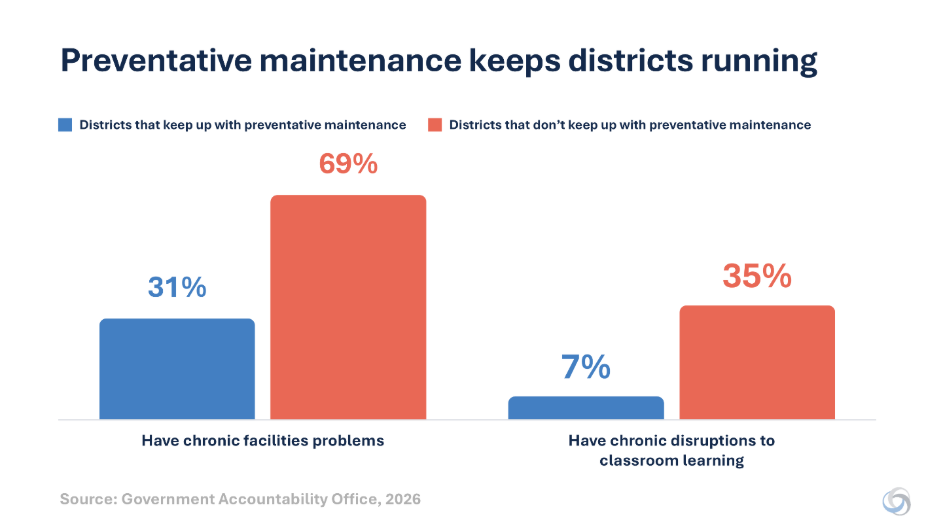
The headline of this report could have been The Power of Preventive Maintenance. For districts that kept up preventive tasks (like servicing boilers or flushing sewer lines), only 31% had a chronic facilities problem and only 7% had an issue that disrupted learning.
But for districts that didn’t have capacity for preventive maintenance, 69% had chronic issues (more than double!) and 35% had classroom learning disrupted (400% more).
Budgets also play a part. 55% of districts called their facilities budget insufficient, and many deferred maintenance, which GAO says can raise costs over time.
Budgets are tight. Given the potential return, preventive measures should be a priority for districts everywhere. One urban district told GAO that investing in preventive HVAC maintenance took its repair calls from 1,500 down to 90 over 7 years.
Some states already tie funding to maintenance. Maryland, for example, gives incentives to districts that rate average or better on its annual assessment of maintenance, and New Mexico requires a preventive maintenance plan before a district can receive state capital funding.
Preventive maintenance runs on records
A preventive maintenance schedule runs on three records. First, an inventory of assets: every boiler, rooftop unit, and light fixture, along with everything else the district maintains, building by building. The second is each asset’s service history: what was done to it and when. Last is the list of open work orders, the repairs and services that have been requested but not completed. The service history is what usually sets the schedule because assets need to be serviced in specific intervals. But all too often, the date of the last service is only known if someone recorded it when the job was finished last time.
To solve for this, districts (and facilities) need a record that lives somewhere everyone can reach.
One platform for the whole operation
ebase is a facilities management platform built for K-12 districts. Its 16 modules cover the work of a facilities department, from maintenance and inspections to rentals, assets, projects and safety records, and they connect to each other with the work order at the center. Requests, work, and history travel with each job, so records don’t depend on the memory of extremely busy people.
ebase also includes unlimited users, so custodians, grounds crews, rentals coordinators and health and safety staff can have their own logins next to the director, and each sees the work that matters to them.
Staff can submit work order requests and attach photos from their phones. At Sooke School District, work orders used to be assigned in one tool and printed out for staff to complete. Today, the majority of staff run them entirely from their phones, and principals and department managers can follow progress without switching between systems. An inspection or audit item becomes a work order directly, and updates are tracked on the work order in real time, so no one has to chase a technician for a status report. On average, ebase users cut the time it takes to assign a work order by 75% compared with their previous system.
The right person is assigned to the job and is given the right context. A work order can go to one or more technicians or outside contractors, and when you assign a tradesperson or contractor you can see their certifications. Before the work starts, the service provider is automatically told about any hazardous substances in that room, and the asset’s maintenance history is there to help diagnose the problem.
Closing out the job builds the record. Parts used on a job are tied to the work order, so stock levels stay accurate, and labor hours are logged against the work they were spent on. Every repair is recorded against the asset, which builds a full maintenance and cost history.
Built around the school year
The average school building is nearly half a century old, so a typical building has decades of repairs behind it. Schools also run on a special calendar: summer is the maintenance window, community groups use gyms and cafeterias on evenings and weekends, and custodial logs recur every day.
ebase was made for K-12 facilities teams and is organized around those routines. Facility Rentals holds the booking, with keys and deposits tracked alongside it, and room bookings for community courses run through Registrations. Digital Logbooks take recurring custodial checklists off paper. And those are just a few of the platform’s 16 modules.
Finally, everything your facilities team does (including preventive maintenance) can be done in one place.